


Demonstration experiences
Demonstration
experiences
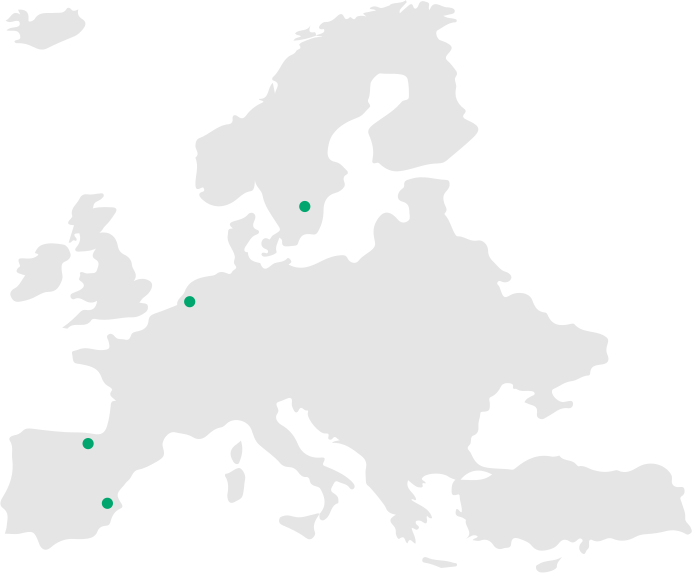
The solution developed in the LIFE Cyanobloom project will be tested to measure its efficiency in 4 European water bodies: The Södra Bergundasjön and Norra Bergundasjön Lakes (Sweden), Lake Westeinderplassen (The Netherlands) and the Bellús and Urrunaga reservoirs (Spain).
Södra Bergundasjön and Norra Bergundasjön Lakes
Växjö, Sweden
Södra Bergundasjön and Norra Bergundasjön lakes are located close to the city of Växjö, Sweden, with more than 70,000 inhabitants, and have for long been characterised by eutrophication problems in the form of massive blue-green algae blooms, nutrient leakage from the bottom, oxygen-depleted bottoms and in some cases fish deaths.
Westeinderplassen Lake
The Netherlands
Lake Westeinderplassen (10 km2) is a relatively shallow lake, originating from peat excavation. On the northern side there are many small islands. The lake is used for commercial shipping as well as for recreation. There are two official bathing water sites. The lake and the bathing water sites are monitored by local water authority Rijnland.
Urrunaga Reservoir
Spain
It is the second biggest reservoir operated by Consorcio de Aguas Bilbao Vizcaya, which supplies more than one million inhabitants, 91.26% of which are from Biscay, which is 48.20% of the total Basque Country population. This reservoir has a maximum capacity of 72 hm3, a surface of 785 ha and a maximum depth of 24.5 m.
Bellús Reservoir
Spain
The Bellús reservoir is a hydraulic infrastructure located in the province of Valencia, in Spain. It is located in the Vall d’Albaida region, in the Albaida river basin, between the municipality of Bellús and the neighbouring town of Benigánim. It was built in 1995 on an area of 703 hectares, with a maximum capacity of 69 hm³ and a maximum depth of 34 m.
